
PLAYING THE ZERO SUM GAME
...and winning

“You take the blue pill, the story ends. You wake up in your bed and believe whatever you want to. You take the red pill, you stay in Wonderland, and I show you how deep the rabbit hole goes“

“The best way to win a zero-sum game is to be good at positive-sum games.”
— John Braddock
Game theory, which is often seen as the “science of strategy,” teaches that winning is rarely about brute force or luck, but rather about anticipating the actions of others and analyzing the structure of the competition. It provides a mathematical framework for making decisions where the outcome depends on the actions of multiple, independent players.
Most “games” you will play are not zero-sum. There does not have a clear winner and loser. Throughout your life there will be zero sum games. Your goal is to win them.
“A zero-sum game is a situation in game theory where one participant’s gain is exactly balanced by another’s loss, resulting in a net change of zero. Total wealth or utility is fixed; it is not created or destroyed.”
Futures & Options: For every investor who profits, another loses an equivalent amount, making it a zero-sum transaction.
Prediction markets
Games of chance: Poker, Chess, heads up betting.
In a zero sum game, in order for you to win someone else has to lose and vice versa.
YOUR GOAL IS TO WIN BY ANY MEANS NECESSARY.
Take this post from
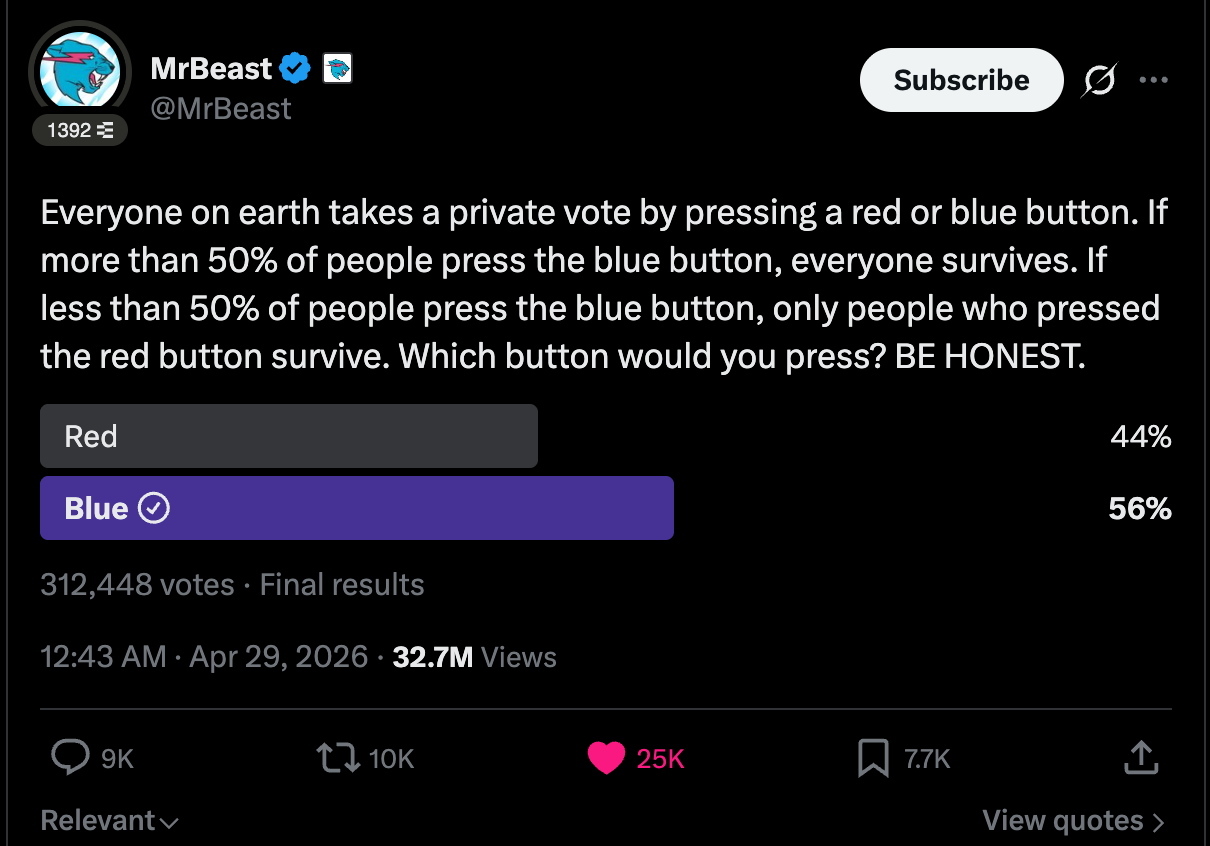
A zero sum game for red and a positive sum game for blue...
which did you choose?
Red = survival on the premise of others not pressing blue
Blue = Everyone survives
There have been so many interpretations of the above, but a phenomenon can be seen outright
The phenomenon where individuals privately disagree with a group norm but mistakenly believe that everyone else supports it—and therefore act in accordance with it—is called Pluralistic Ignorance.
This paradox results in a collective fallacy where everyone thinks they are the only ones holding a contrarian view, leading them to stay silent or conform to an opinion that no one actually supports, but everyone thinks everyone else does.
This is an interesting situation because it can be both a win-win and a win-lose situation depending on how the game is played.

WINNING THE ZERO SUM GAME
1. The Minimax Theorem (Minimize Maximum Loss)
Formulated by John von Neumann, this theorem states that players should choose strategies that minimize their maximum potential losses. In a competitive, winner-take-all scenario, the focus is not solely on attacking the opponent but ensuring that even if the opponent plays perfectly, your own minimum gain is as high as possible.
Think of this as a stop loss. In the event of you losing the game, the maximum amount you can lose is mitigated. There are deterrents.
Not going “all in” on a bad poker hand.
When trading financial markets, have stop losses in place for draw downs
Having multiple “next moves” planned in chess as a contingency
2. Mixed Strategies (Avoid Predictability)
When you as a player use a single, repeated approach (a “pure strategy”), you become predictable and easily defeated. Game theory recommends “mixing” actions choosing from several options with specific probabilities to remain unpredictable.
The same chess opening can be easily defeated.
A repeated poker pattern can be identified.
Do not let your opponent so easily best you by implementing the same strategies over and over again.
3. Nash Equilibrium in Zero-Sum
A Nash equilibrium is a state where no player can benefit by unilaterally changing their strategy. In a zero-sum game, this happens when both players play their optimal mixed strategies simultaneously.
When an unstoppable force meets an immovable object.
4. Saddle Points (Pure Strategy)
Some games have a “saddle point” a specific move where the row player (trying to maximize) and the column player (trying to minimize) both find their best response. If a saddle point exists, a “pure strategy” (never changing) is optimal.
5. Strategic Information Gathering
Because zero-sum games are strictly competitive (the “pie” cannot be enlarged), the best strategy often involves gathering information to predict the opponent’s probability of choosing specific actions.
In a zero sum game, it is a war of attrition. You have to play the cards you have been dealt against the hands your opponents have been dealt. A pure game.
THE POSITIVE SUM GAME
A positive-sum game is a game theory scenario where total gains and losses exceed zero, meaning all participants can benefit or “win” simultaneously. A win-win scenario.
It has been said that to get good at winning zero sum games, you must first master positive sum games.
Seeing the world as a positive-sum game encourages building, creating, and long-term cooperation rather than short-term competition. It is often considered the optimal approach to maximize personal and collective gains over time.
Cooperation over Competition: In scenarios like the Prisoner’s Dilemma, mutual cooperation often yields better long-term payoffs than mutual defection, even though cheating provides a short-term benefit.
Value Creation (Expanding the Pie): Rather than fighting over a fixed amount of resources, players should focus on increasing the total value available, such as in trade where both sides gain (positive-sum).
Iterated Games & Reputation: When games are played repeatedly, building a reputation for fairness and cooperation encourages others to cooperate, leading to higher cumulative rewards.
Pareto Efficiency: A successful outcome is often defined as Pareto optimal, meaning it is impossible to make one player better off without making at least one other player worse off.
Strategic Flexibility: While rational players still seek to maximize their payoffs, they must account for the fact that their success is contingent on the actions of others.
There are many examples of positive sum games where co-operation are key.
Life is a series of positive sum and zero sum games, with the ultimate goal being you on top.
Key Strategies for Success
Cooperation Over Competition: Unlike zero-sum games, non-zero-sum games allow both parties to win, so focus on joint maximization.
Nash Equilibrium Formulation: Identify strategies where neither party can benefit by changing their approach unilaterally.
Trust and Communication: Establishing credibility and clear communication helps facilitate cooperation, reducing the likelihood of mutual losses.
Long-Term Perspective: Focusing on long-term gains often incentivizes cooperation, making it better to choose strategies that benefit both parties over time rather than a single-shot gain.

Win and help win. A rising tide lifts all boats.
this is how we win 😤
yeah digi shifting out of a zero-sum mindset opens the door to growth, collaboration, and opportunities that didn’t even exist before